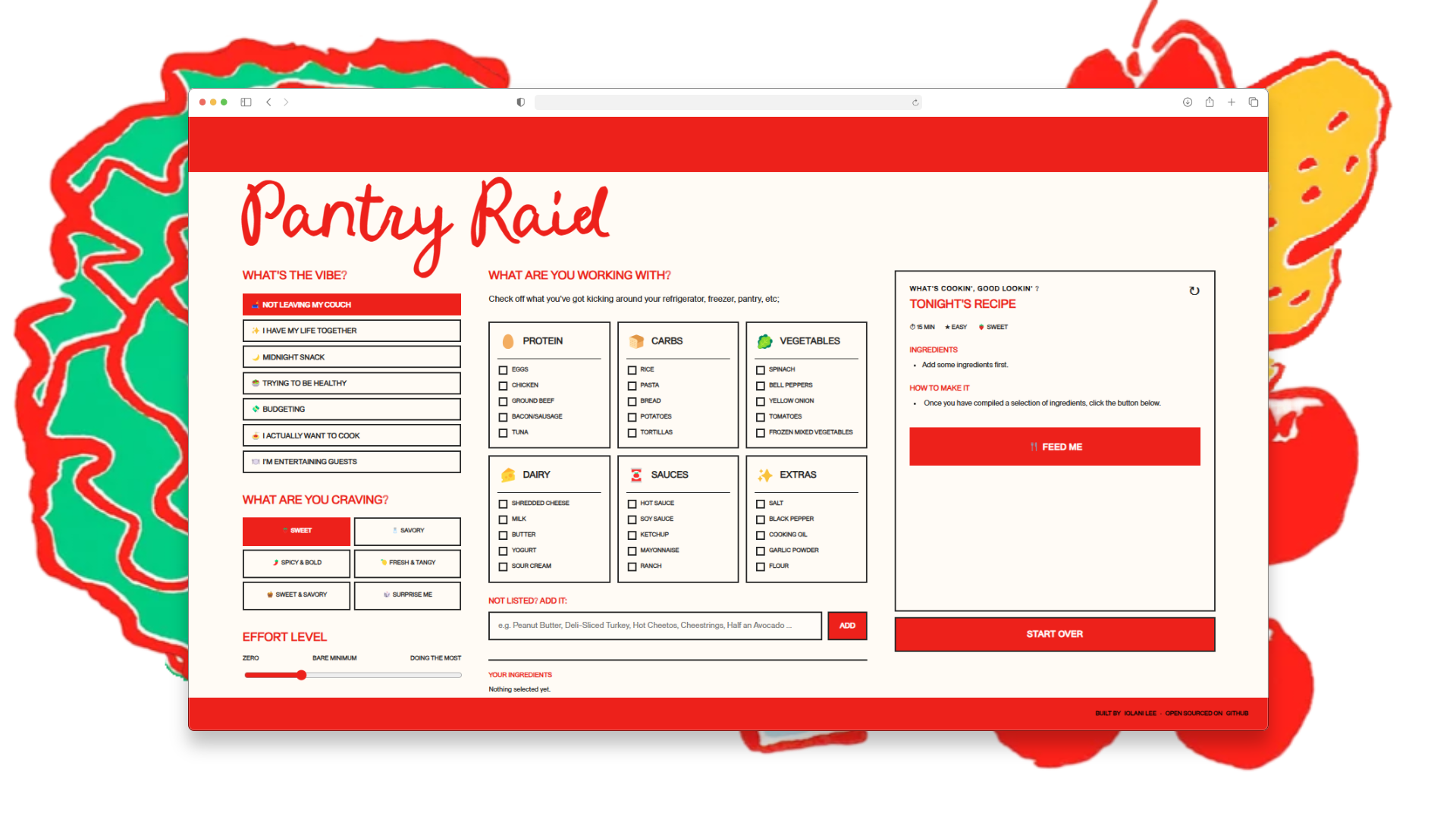
Pantry Raid is an AI-powered recipe generator inspired by the concept of “girl dinner” — making a meal out of whatever happens to be available.
The name plays on the phrase “panty raid,” reimagined as a playful “raid” of the pantry for meal inspiration. This became the foundation for a recipe experience that embraces spontaneity while solving a practical problem: What can I actually make with what I already have?
Built with the Google Gemini API, Pantry Raid generates personalized recipes based on a user's available ingredients, cravings, hunger level, mood, and desired effort. The project combines generative AI with an intentionally playful brand and intuitive interface to create a cooking experience that feels both useful and fun.
The goal of Pantry Raid was to solve a simple but common problem: "I have food or ingredients, but I don't know what to make."
I wanted to build an application that reduces decision fatigue while encouraging users to make use of ingredients they already have. Rather than functioning as a traditional recipe database, Pantry Raid uses generative AI to create flexible, personalized suggestions based on the user's available ingredients and preferences.
From a development perspective, the project also gave me an opportunity to work with an external AI API and explore how generative AI can be integrated into a practical, user-focused web application.
The UI was intentionally designed to feel playful, approachable, and low-pressure rather than like a traditional recipe or meal-planning application.
Users move through a series of simple choices: their current vibe, what they're craving, how much effort they want to put in, how hungry they are, and which ingredients they have available. Ingredients are organized into familiar categories such as protein, carbs, vegetables, dairy, sauces, and extras, making the selection process quick and intuitive.
The interface uses conversational copy, emojis, and personality-driven labels such as "Not Leaving My Couch," "Midnight Snack," and "Doing the Most" to make the experience feel more like interacting with a personality than filling out a form. The generated recipe is then presented as the payoff of that interaction, with the ingredients and preparation steps clearly separated for easy scanning.
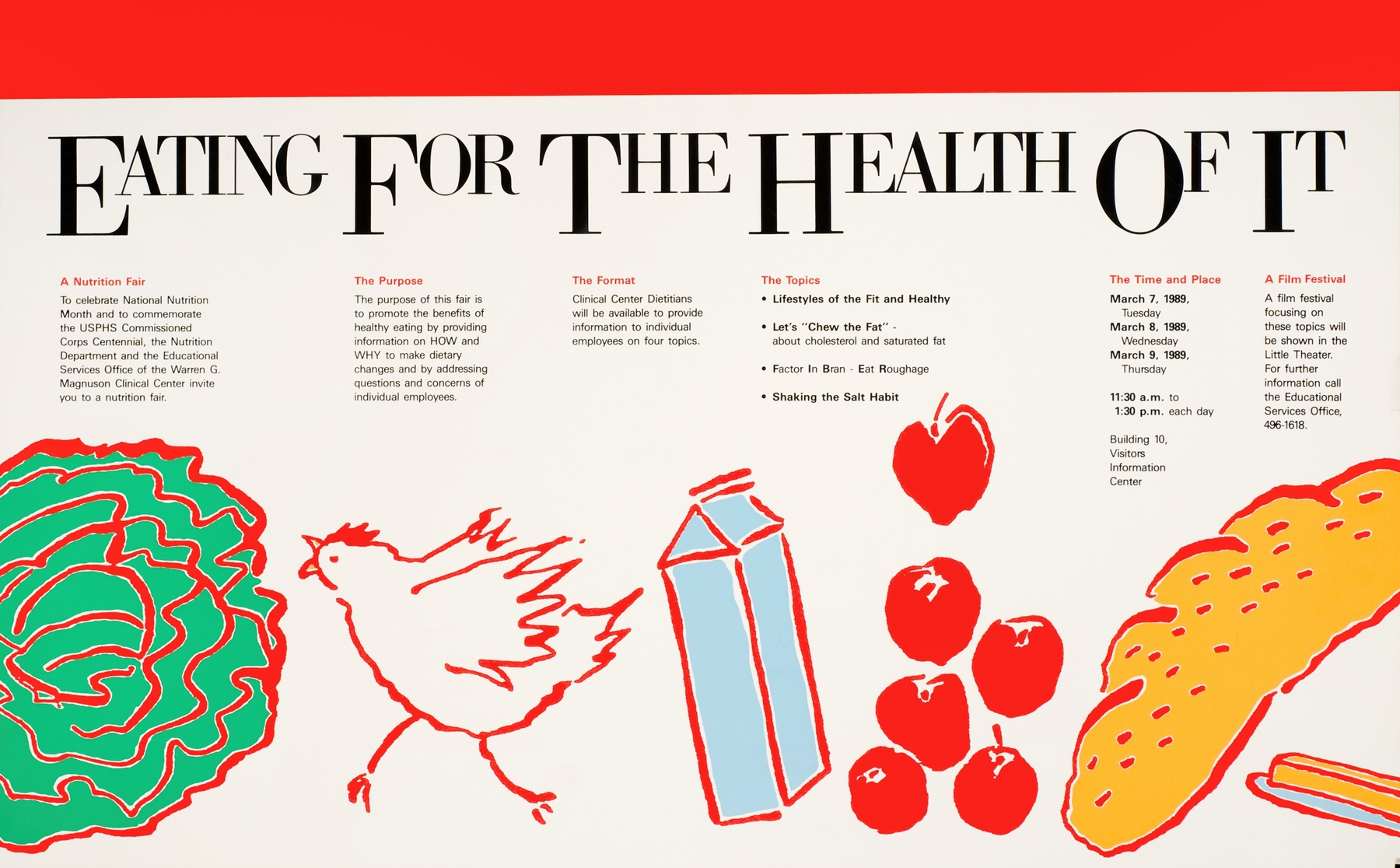
Eating for the health of it, 1989. U.S. National Institutes of Health, Clinical Center, Nutrition Department. National Library of Medicine, Images from the History of Medicine collection.
The visual identity is based directly on Eating for the Health of It, a 1989 public health poster created by the Nutrition Department of the NIH Clinical Center. I closely replicated elements of the original poster, including its color palette, food illustrations, and overall visual composition, and recontextualized them for Pantry Raid.
The reference felt particularly appropriate because the poster makes familiar, everyday foods the focus of its visual language. Pantry Raid does the same, but reinterprets those ingredients for a completely different experience.
Where the original poster uses food to communicate nutrition and healthy eating, Pantry Raid uses food to communicate spontaneity and possibility. The retro public-health aesthetic is paired with playful copy, and the contemporary “girl dinner” concept to create a contrast between the poster's institutional origins and Pantry Raid's casual personality.
The result is a visual language that feels nostalgic and familiar while supporting the core idea of the product: taking whatever you already have and turning it into something unexpectedly good.
Aa Bb Cc 123
Aa Bb Cc 123
Pantry Raid is a full-stack-style frontend project that combines interactive UI design, user input management, API integration, and generative AI into a single experience.
The application demonstrates my ability to take a familiar problem and build a solution around it while considering both the technical implementation and the user's experience. The project also gave me hands-on experience working with the Google Gemini API, structuring dynamic user inputs, and turning AI-generated output into a polished, usable interface.
Ultimately, this project showcases how I approach development as more than simply making an application function — I aim to create experiences that are intuitive, visually engaging, and genuinely useful.